

MAIN TECHNICAL ARTICLE
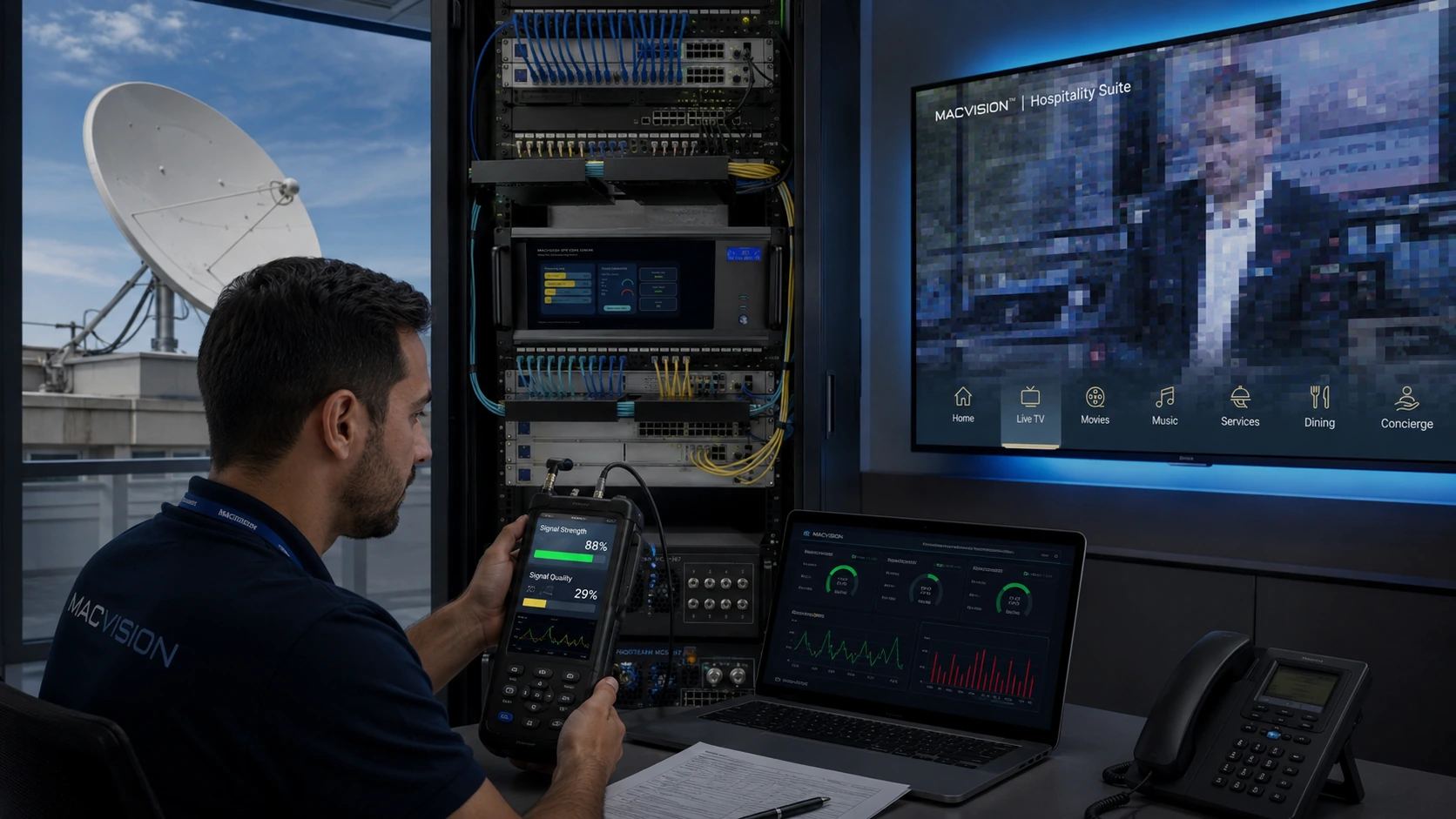
A satellite meter can show strong RF power while the received transport stream is still unreliable. Strength indicates the amount of signal reaching the tuner, but quality depends on correct satellite lock, carrier-to-noise ratio, modulation error ratio and bit error rate. A dish pointed slightly away from the target satellite, an incorrect LNB skew, interference, a damaged connector or an overloaded tuner can therefore produce a high-strength reading with unstable IPTV output. The headend may remain locked yet forward corrupted packets, causing pixelation, audio breaks, freezing or intermittent black screens on televisions.
Why can a satellite meter show high strength while IPTV channels still freeze?
Answer: High strength only confirms that RF energy is present at the input. It does not prove that the wanted transponder is clean or correctly demodulated. The tuner may be receiving the wrong satellite, excessive noise, cross-polarized interference or a signal level high enough to overload its front end. In each case, the decoder receives transport-stream errors even though the strength bar looks healthy. The correct verification is to check the required transponder lock together with MER, C/N and pre- and post-correction BER, then observe whether continuity-counter errors appear at the headend output.
Which measurements should be checked when signal strength is good but picture quality is bad?
Answer: Measure the weakest required transponder rather than a convenient strong one. Confirm satellite identification, frequency, symbol rate and polarity, then record C/N or MER and BER at the dish, after the multiswitch and at the headend tuner. Compare values at each point to locate where degradation begins. A spectrum view is also useful for detecting adjacent-satellite energy, excessive noise floor, compression from an amplifier or an incorrect high-band/low-band selection. Stable IPTV service requires adequate quality margin, not merely a tuner lock indication.
How is a high-strength, low-quality satellite feed corrected before IPTV encoding?
Answer: Start by reducing variables: connect a calibrated meter directly to the LNB, verify the target satellite and optimize azimuth, elevation and skew for maximum quality. Inspect the F-connectors, cable shielding, earth bonding and water ingress. Confirm the LNB local-oscillator values and 13/18 V plus 22 kHz switching. If the direct feed is clean, reconnect the multiswitch and headend stages one at a time. Add attenuation only when the tuner input is above its specified level; never use attenuation to hide poor MER or interference.