

MAIN TECHNICAL ARTICLE
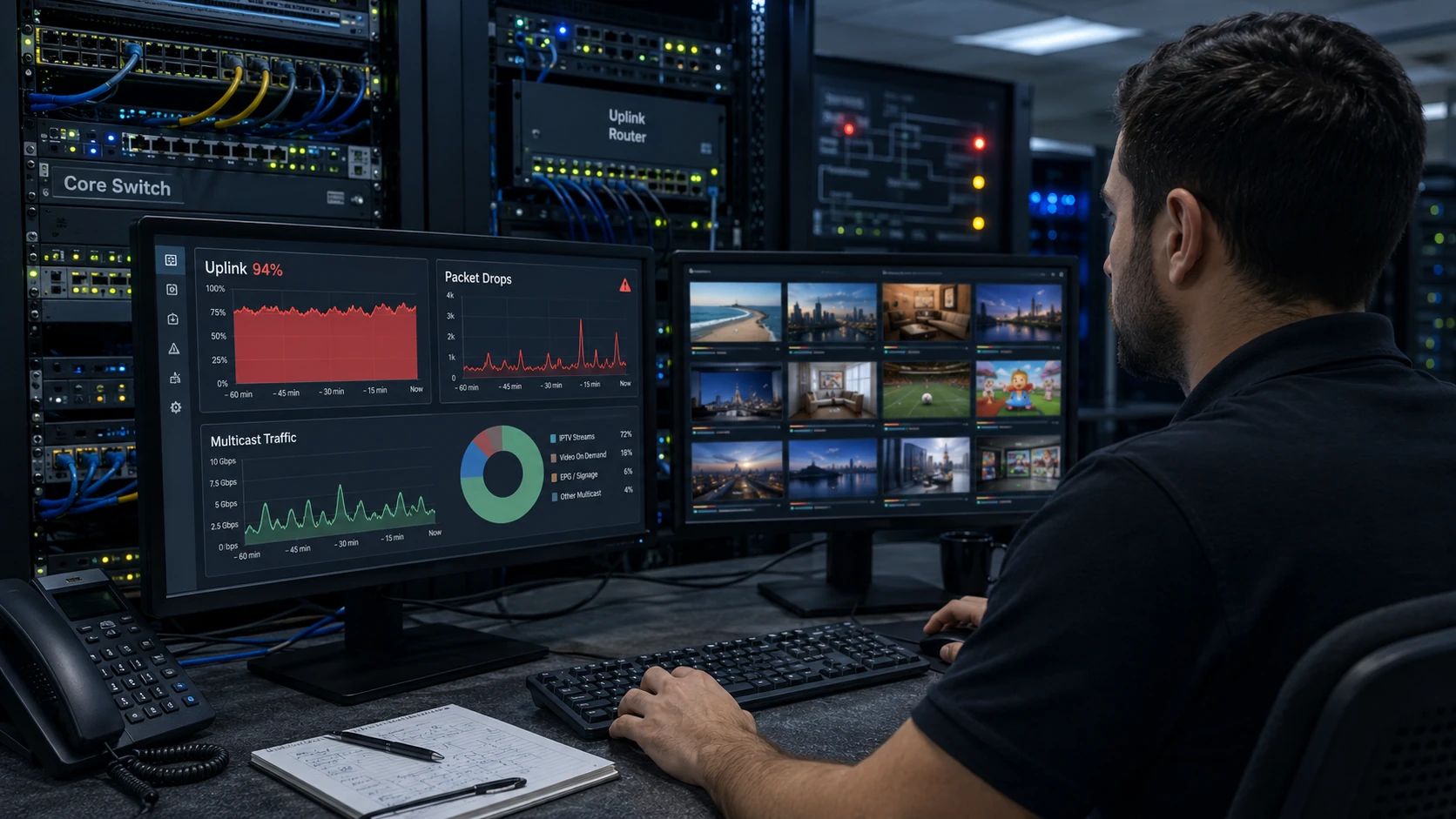
A floor switch may serve dozens of televisions while one uplink carries all requested channels, middleware traffic and other services. In multicast, uplink usage depends on the number of distinct groups requested downstream, not simply the number of TVs. In unicast, every viewing session adds another full stream. Incorrect assumptions about this difference can lead to congestion during peak occupancy.
How is multicast uplink bandwidth calculated for a hotel floor?
Answer: Add the bitrate of each distinct channel group currently requested on that floor, plus protocol overhead and margin. Ten TVs watching the same multicast channel consume roughly one copy on the uplink, while ten TVs watching ten different channels consume ten streams. The worst case may approach the full lineup if viewing is diverse. Use actual channel peak bitrates and include control and other VLAN traffic when sizing the link.
Why does a unicast IPTV system require more uplink and server capacity?
Answer: Each endpoint receives an individual stream, even when many guests watch the same program. Concurrent session count therefore multiplies bitrate through the server and network. Unicast enables personalization and routed delivery but must be engineered for peak occupancy and popular-event demand. Monitor server NIC, CPU, session limits and every aggregation link; a single bottleneck can affect many rooms.
When should a hotel upgrade from 1 Gbps to 10 Gbps uplinks?
Answer: Upgrade when measured or calculated peak traffic, including growth and redundancy, approaches a level that leaves inadequate operating margin, or when queue drops appear during bursts. Large channel lineups, unicast delivery, multiple floors or converged storage and internet traffic can justify 10 Gbps. Verify switch fabric, optics, fiber and core capacity end to end so one upgraded link does not move the bottleneck elsewhere.