

MAIN TECHNICAL ARTICLE
End-to-end troubleshooting prevents teams from repeatedly rebooting devices or changing unrelated settings. The signal path should be checked in order: satellite and LNB, RF distribution, tuner and service selection, decryption, encoding, multicast or unicast delivery, middleware mapping, access network, endpoint application and display output. At each boundary, verify whether the signal is correct before moving downstream. This isolates the first failing stage and protects approved channel numbering and guest configuration.
What is the correct order for diagnosing a failed IPTV channel?
Answer: Confirm whether the fault affects one channel, one transponder, one device type, one floor or the entire property. Check source RF quality and tuner lock, then service ID, PIDs and decryption. Validate the headend IP output with continuity analysis, confirm network group forwarding and finally inspect middleware mapping and endpoint decoding. Stop at the first point where the known-good signal becomes faulty. This order avoids using a TV reset to mask an unstable satellite source or moving a dish for a VLAN error.
Which evidence should be collected before changing an IPTV configuration?
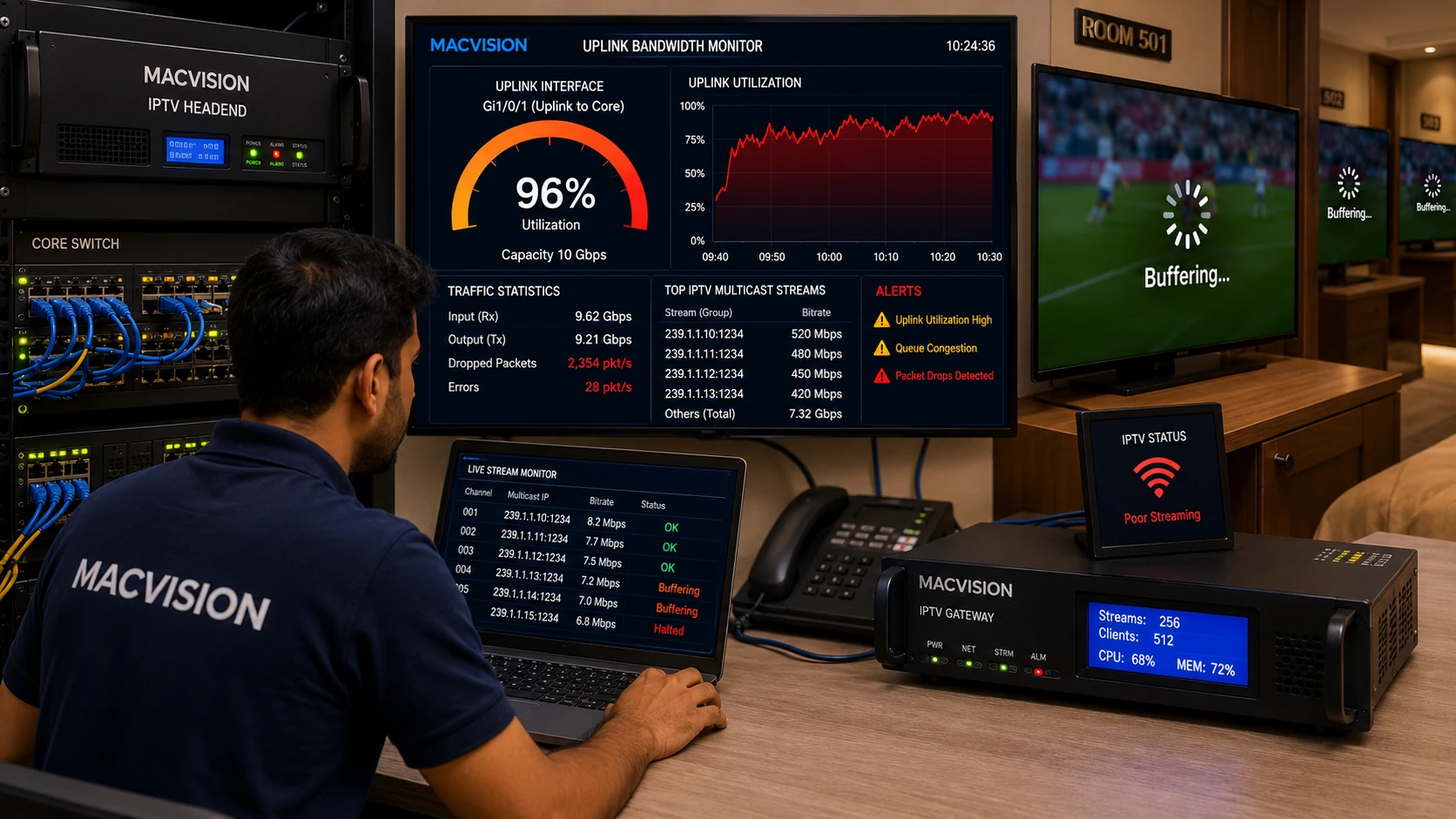
Answer: Record affected channels and rooms, timestamps, weather, tuner metrics, service identifiers, multicast addresses, switch counters, server logs, endpoint model and firmware. Capture a short sample at relevant boundaries when permitted. Save configuration backups and note the original values. Evidence allows teams to correlate failures and roll back safely; undocumented simultaneous changes can make the channel appear fixed while creating a future fault elsewhere.
How is an IPTV repair accepted and closed professionally?
Answer: Retest the original symptom and related services under realistic load. Verify RF margin, transport continuity, packet loss, channel switching, audio, subtitles, EPG, middleware authorization and restart recovery on representative LG, Samsung and STB endpoints. Monitor for a defined stability period, update the as-built documentation and record replaced components and final measurements. Close the incident only when the root cause and preventive action are documented, not merely when one screen shows a picture.