

MAIN TECHNICAL ARTICLE
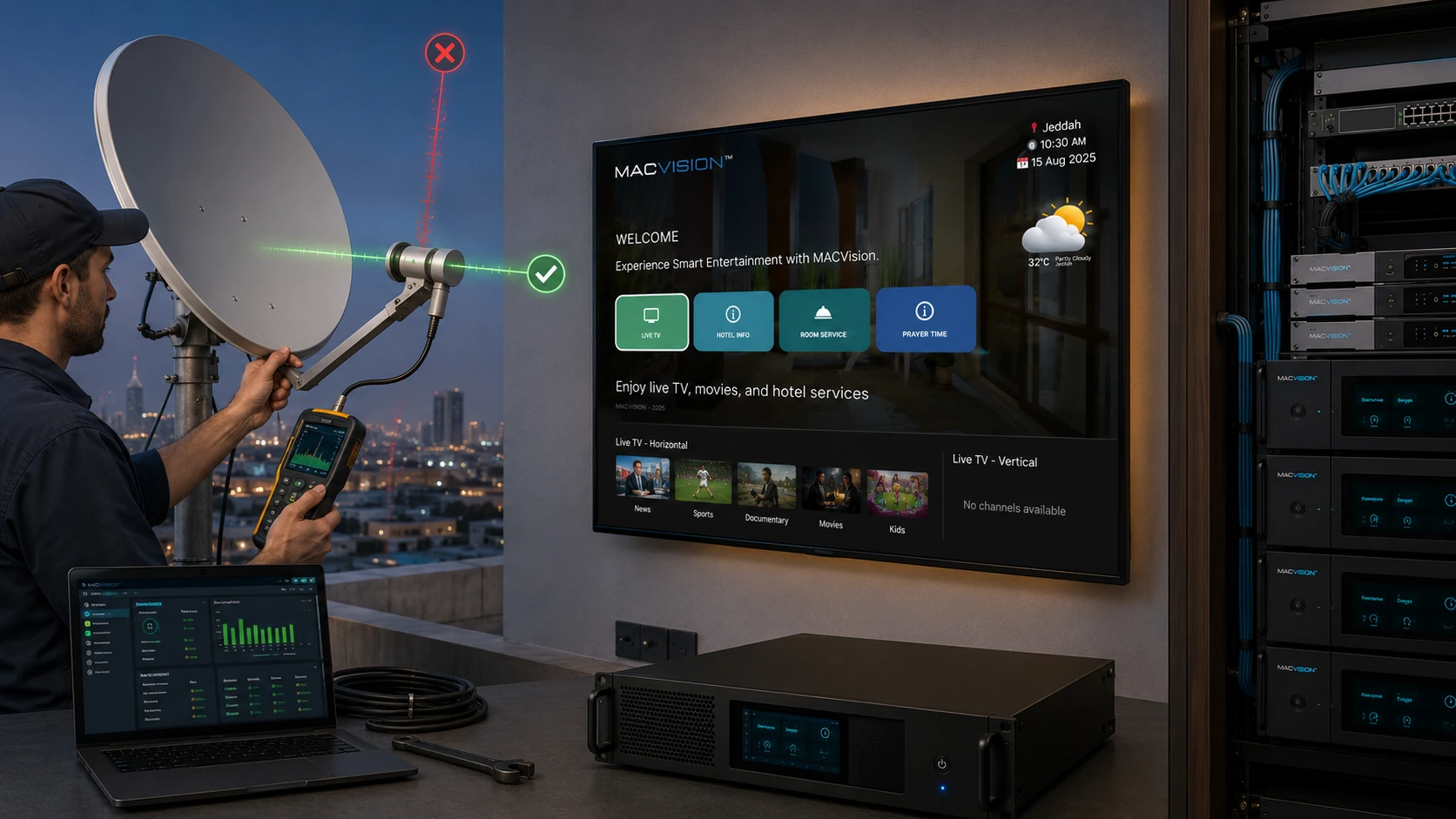
A system that receives horizontal services but loses vertical services normally has a fault in the lower-voltage polarization path. The tuner may remain at 18 V, a multiswitch vertical input may be absent, a receiver configuration may force horizontal polarity, or a power inserter may override the expected 13 V selection. Unlike random channel loss, this failure follows a clear transponder pattern. Correct diagnosis requires voltage measurement under operating conditions and verification of the relevant vertical low-band and vertical high-band paths.
Why would an IPTV headend receive horizontal transponders but no vertical transponders?
Answer: The tuner or distribution system may be unable to switch down to the vertical-selection voltage. A defective regulator can hold the output near 18 V, while an external power supply or powered multiswitch can override the tuner command. A missing vertical input on a Quattro-LNB multiswitch produces the same symptom across all connected tuners. Also confirm that the channel database does not contain an incorrect horizontal polarity entry, because a configuration error can imitate a hardware fault.
Which field tests identify a missing 13 V vertical path?
Answer: Tune a known vertical transponder and measure DC voltage at the headend tuner output and again at the distribution input. The voltage should change from the horizontal level to the vertical level. If it does not change at the tuner, inspect the tuner settings or hardware. If it changes at the source but not at the LNB or multiswitch input, investigate cable resistance, power inserters, DC-pass routing and connectors. A direct test with a known-good receiver helps separate headend configuration from external RF distribution faults.
What checks are required after restoring vertical satellite channels?
Answer: Test at least one vertical low-band and one vertical high-band transponder, then confirm that switching back to horizontal still works. Measure MER and BER to ensure the repair restored quality rather than only carrier lock. Review the multiswitch port labels and verify that VL, VH, HL and HH feeds are connected to the matching inputs. Finally monitor the IPTV output for continuity errors and confirm that channels on the repaired path remain stable during repeated tuning and headend restarts.