

MAIN TECHNICAL ARTICLE
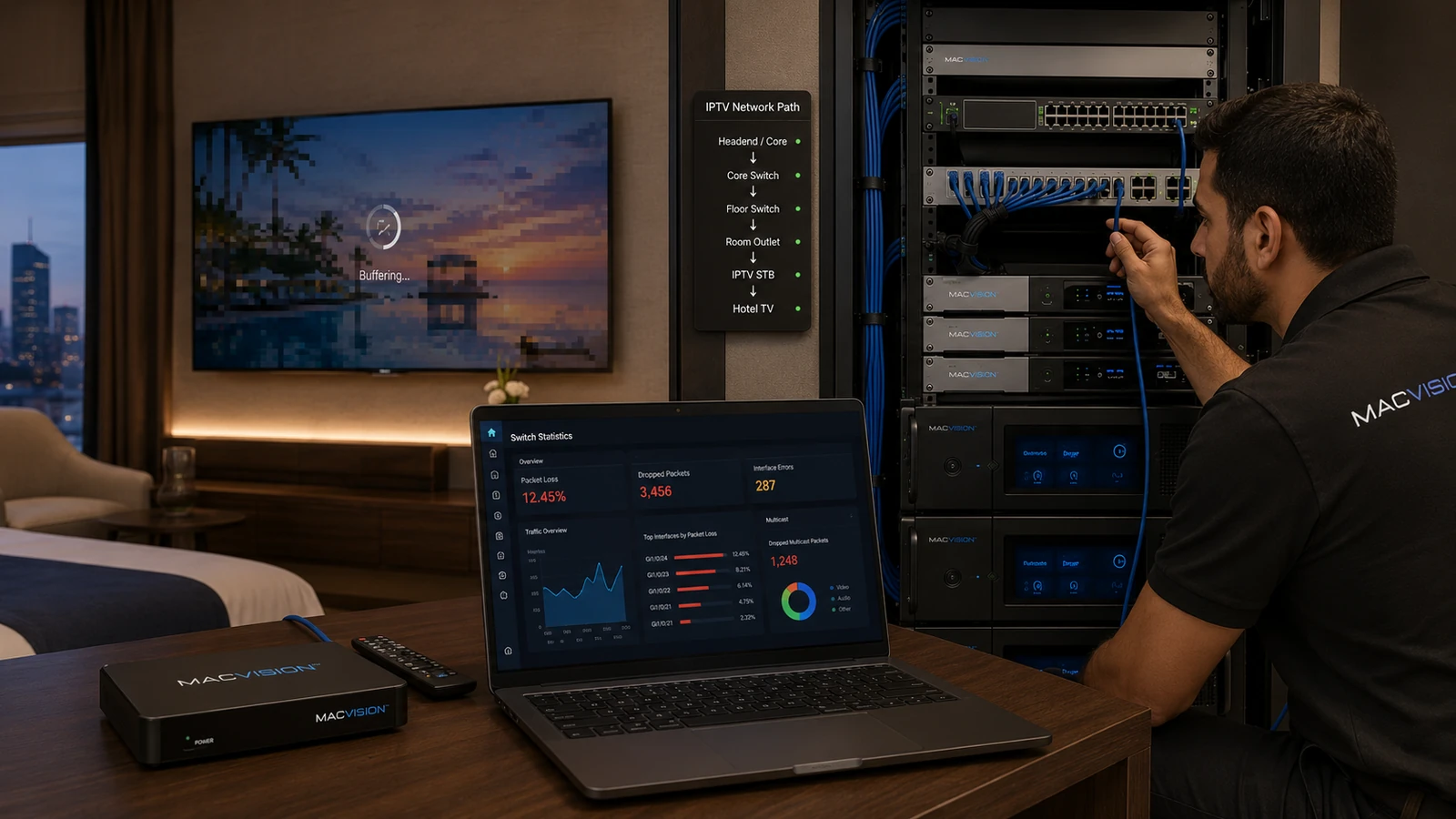
IPTV video is highly sensitive to packet loss because a missing packet may contain part of a compressed reference frame used by many following frames. UDP multicast normally does not retransmit lost data, so the decoder must conceal the error until a new clean reference point arrives. Loss can originate at congested interfaces, faulty cables, overloaded switches, duplex problems, wireless links or the source server. The visible pattern depends on which packets are lost and how quickly the stream provides recovery frames.
Why can a very small percentage of packet loss cause obvious IPTV picture damage?
Answer: Compressed video does not treat every packet independently. Losing data from an I-frame or important motion reference can corrupt many subsequent frames, while losing one audio packet may create a brief click or silence. A one-percent loss rate is therefore not a minor defect for live video. Measure loss and sequence discontinuities over the actual channel path, and correlate them with decoder errors. The acceptable target for a managed IPTV LAN should be effectively zero sustained packet loss under peak load.
How can network packet loss be separated from satellite transport-stream errors?
Answer: Inspect continuity counters at the tuner or encoder input and again at the IP output. If errors already exist before packetization, the RF source is responsible. If the source transport stream is clean but packet captures show missing RTP sequence numbers or switch counters show drops, the network is responsible. Capture near both the headend and affected TV to identify the segment where packets disappear. This prevents unnecessary dish alignment when the actual fault is an uplink or cable.
What actions normally eliminate packet-loss-related IPTV freezing?
Answer: Repair physical errors, remove congestion, correct speed or duplex negotiation, increase uplink capacity and configure multicast so traffic reaches only requesting ports. Review queue drops, switch buffers and QoS under peak conditions. Replace faulty patch leads, SFPs or cable runs that show CRC errors. After correction, monitor sequence continuity on several channels and test simultaneous room usage. Increasing TV buffer size may hide very short bursts but is not a substitute for a loss-free network.