

MAIN TECHNICAL ARTICLE
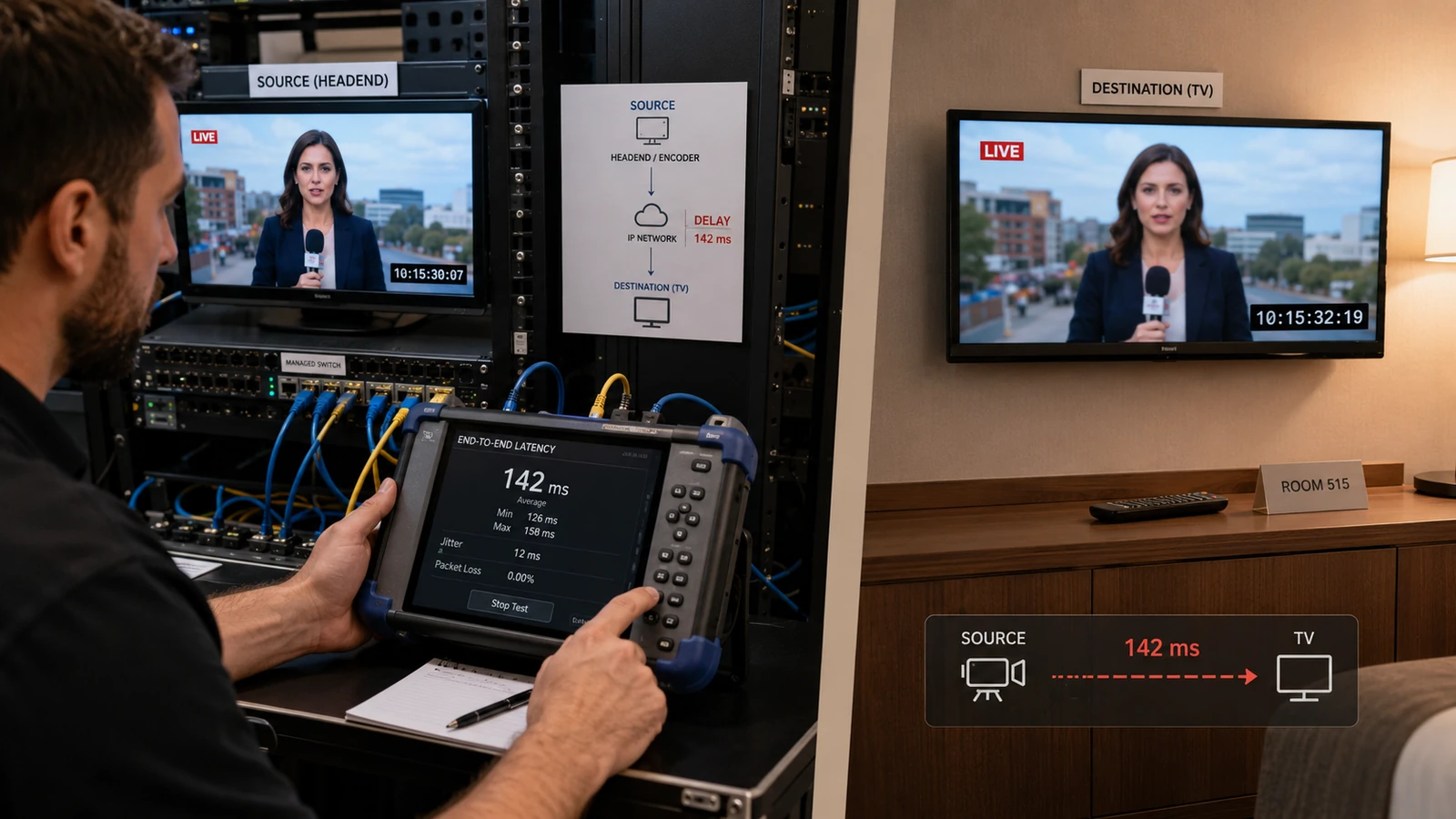
On a local multicast network, one-way latency is usually less important than loss and jitter, because viewers watch a continuous stream rather than interact with each packet. Latency becomes important for channel-change speed, synchronized displays, remote-site delivery, interactive middleware and live events where delay from the source matters. The cause can include long routing paths, transcoding, buffering, VPN tunnels, satellite contribution or overloaded servers.
Does high ping time always cause IPTV freezing?
Answer: No. A stable stream can play with significant fixed latency if packets arrive in order and without loss. Freezing is more often caused by loss, jitter or buffer underflow. However, high latency can reveal congestion and can worsen control response, channel joins and interactive functions. Evaluate one-way media delay, packet variation and drops separately from ICMP ping. A low ping does not guarantee clean multicast, and a high but stable ping does not automatically explain picture breakup.
Why can channel switching be slow even when playback is stable?
Answer: The delay includes middleware authorization, IGMP group leave and join, network forwarding state, arrival of the next decoder keyframe and endpoint buffer fill. A long GOP or large buffer can dominate even on a low-latency LAN. Measure each stage rather than attributing the full delay to the network. Packet capture can show when the join is sent, when multicast arrives and when the first keyframe appears.
How can end-to-end IPTV delay be reduced for live events or synchronized screens?
Answer: Remove unnecessary transcoding and buffering, shorten encoder GOP where quality and bitrate allow, use low-latency contribution paths and keep routing direct. Ensure multicast joins are processed quickly and clocks are synchronized when displays must align. Use purpose-built synchronization or genlock features for video walls; ordinary IPTV receivers may decode at slightly different times. Validate reduction against picture stability because overly small buffers can convert delay improvement into visible jitter.