

MAIN TECHNICAL ARTICLE
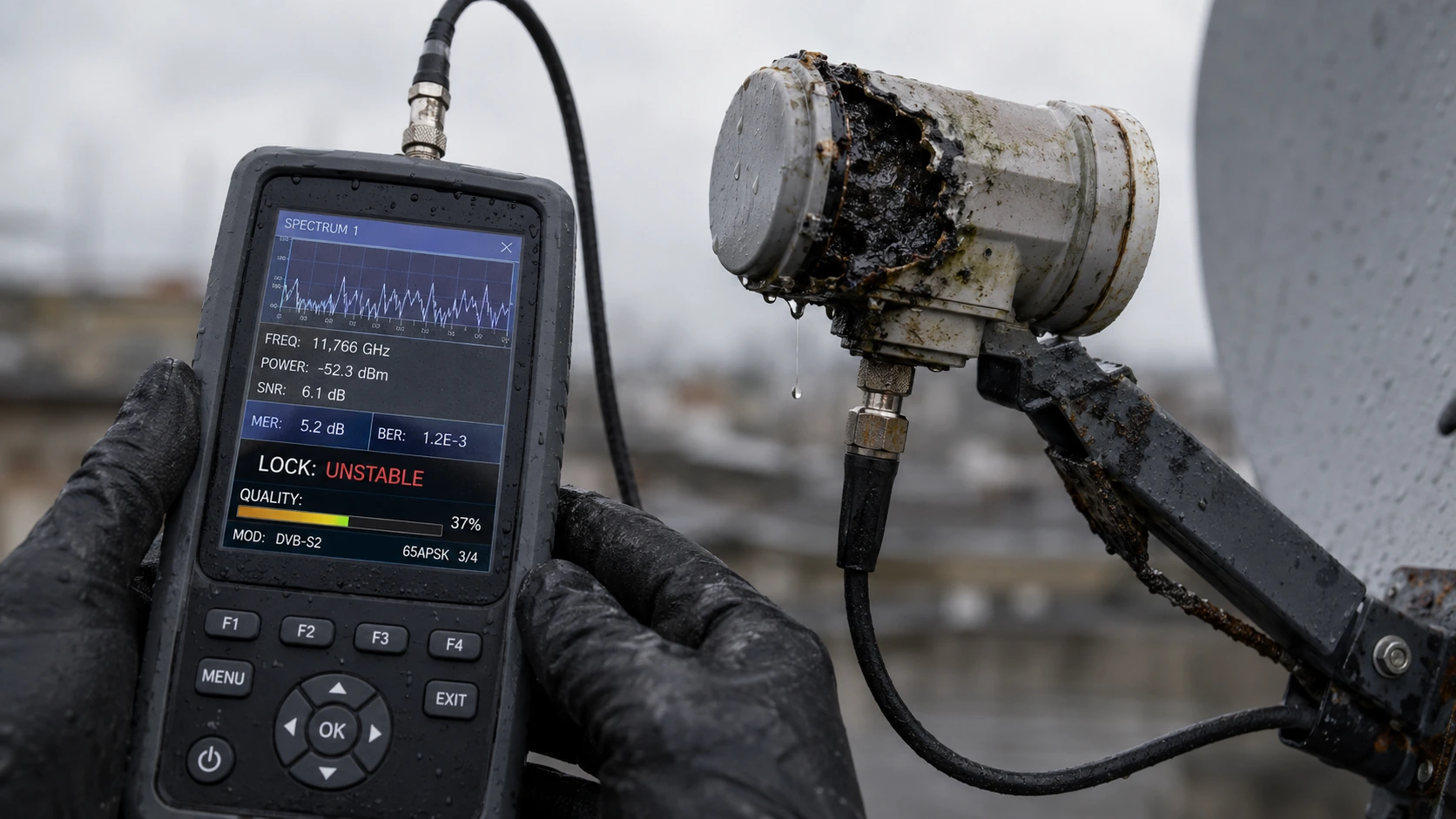
An LNB contains a low-noise amplifier, local oscillators and polarization/band switching circuits exposed to heat, moisture and continuous power. Failure may be total or intermittent. Common patterns include one missing band, one missing polarization, frequency drift, increased noise, temperature-dependent channel loss or repeated lock changes. Because the LNB is shared by multiple tuners or a multiswitch, one fault can affect many IPTV channels at once.
What channel symptoms normally indicate a failing satellite LNB?
Answer: Look for failures grouped by polarization or band, quality that changes as the LNB warms, frequency offsets, unstable lock on several unrelated tuners and a rising noise floor across the spectrum. A complete LNB failure removes all services, but partial failures are more common. Water ingress can create intermittent problems after rain, while oscillator drift may affect only narrow-lock transponders. Compare direct measurements at the LNB with historical values and with a known-good replacement before changing headend equipment.
How can an LNB be tested without disconnecting the entire IPTV service?
Answer: Use a spare output where available or install a temporary test connection through an approved isolation method. Measure representative VL, VH, HL and HH transponders directly at the feed and compare quality with the headend input. Check DC current draw and confirm correct response to voltage and 22 kHz commands. If the problem is intermittent, observe cold-start and warmed operation. A substitution test with an identical known-good LNB is often the fastest confirmation, provided dish position is not disturbed.
What should be considered when replacing an LNB in a live IPTV installation?
Answer: Match the LNB architecture, oscillator frequencies, noise and output type to the existing design. Mark the original skew and feed position before removal, then fine-tune the replacement using quality measurements rather than copying the old angle blindly. Weatherproof all connectors and verify current draw. After replacement, test every required band and polarization, rescan only if frequencies changed and confirm that encrypted services still pass through their assigned tuners and CAMs. Keep the old unit isolated until the new feed has passed a stability period.