

MAIN TECHNICAL ARTICLE
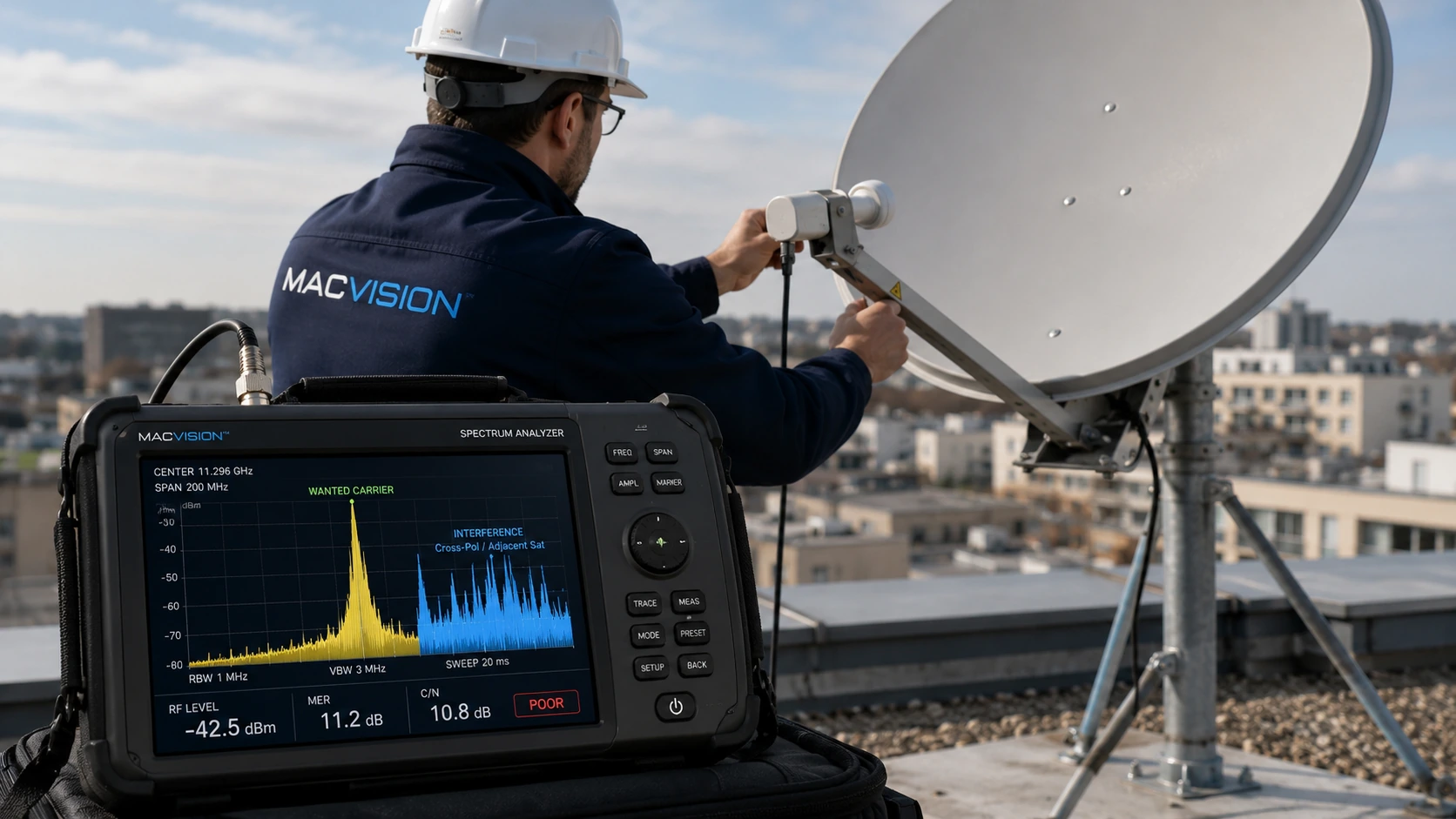
Interference can come from an adjacent satellite, the opposite polarization, terrestrial microwave sources, poor shielding or an overloaded active component. The wanted carrier may still show good level, but MER and BER deteriorate because the tuner cannot separate the modulation reliably. Interference faults often affect particular frequencies and may vary with dish movement, nearby equipment or weather. A spectrum analyzer and polarization testing are usually required to separate interference from simple low signal.
How can adjacent-satellite interference cause IPTV pixelation despite good signal level?
Answer: A dish with insufficient size, inaccurate pointing or distorted shape may receive significant energy from a nearby orbital slot. The unwanted carrier raises the effective noise and can overlap or sit close to the wanted transponder. The meter then reports strong total power while the demodulator sees reduced MER. Re-peak the reflector on the wanted satellite, confirm the mount is rigid and evaluate whether a larger or better-quality dish is needed for narrower beamwidth and improved adjacent-satellite rejection.
What is the difference between cross-polarization interference and ordinary low signal?
Answer: Low signal reduces the wanted carrier level relative to the receiver noise floor. Cross-polarization interference adds energy from the opposite polarization because LNB skew or antenna polarization isolation is poor. Increasing amplification may help neither problem and can worsen overload. Rotate the LNB while monitoring quality and compare the wanted carrier with the opposite-polarized carrier. A large quality change with rotation indicates polarization isolation is involved, whereas equal degradation across both polarizations may point to alignment, obstruction or cable loss.
How should interference entering a satellite IPTV headend be mitigated?
Answer: Identify the source before adding filters or amplifiers. Check dish alignment, reflector condition, feed centering, skew and line of sight. Inspect shielding and grounding and bypass active RF components to rule out internally generated distortion. If terrestrial interference occupies a known band, use a suitable filter that does not remove required transponders. For persistent adjacent-satellite issues, improve antenna discrimination through correct dish size and installation. Confirm success by improved MER and lower BER, not only by a change in RF level.