

MAIN TECHNICAL ARTICLE
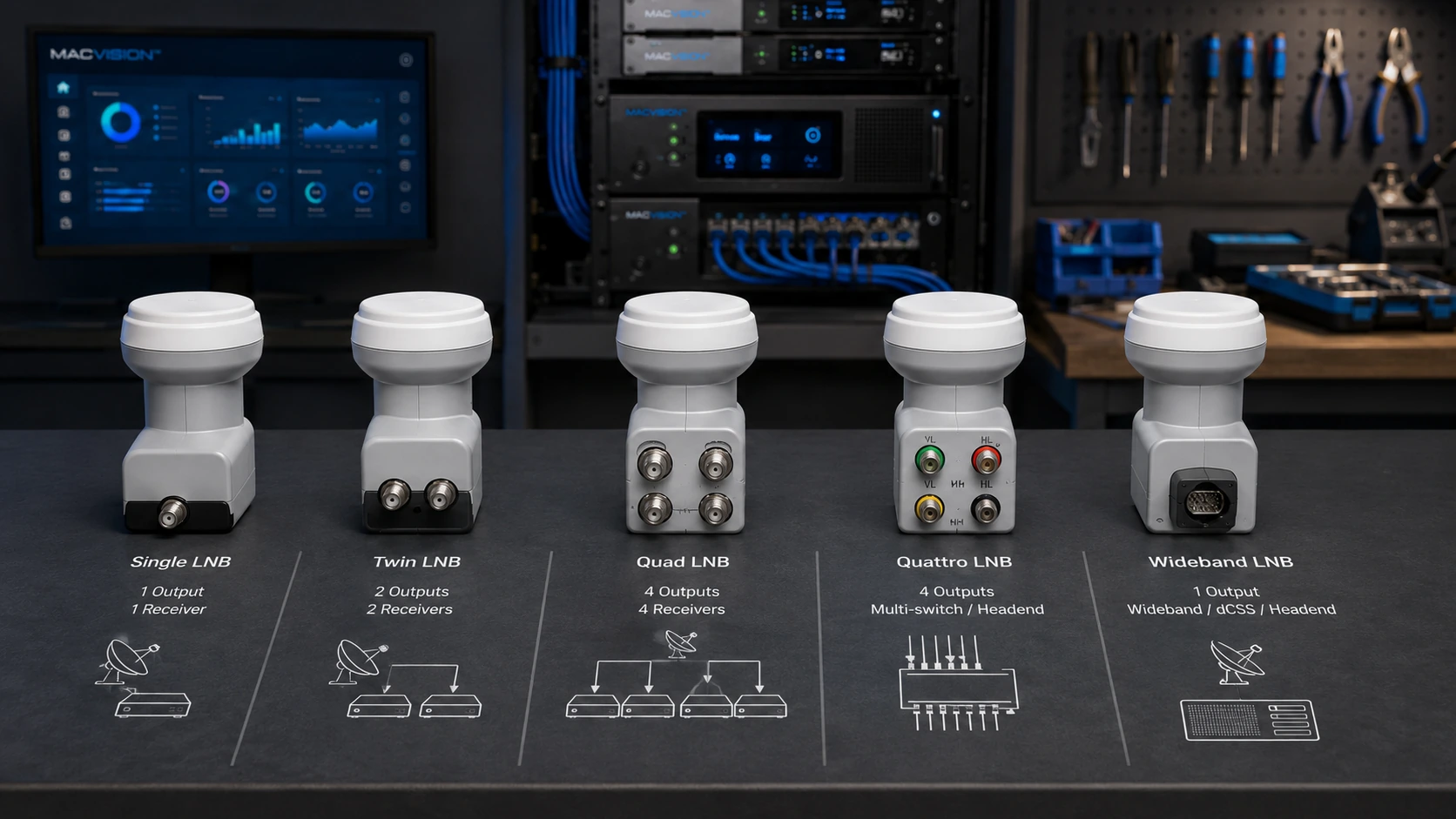
LNB output type must match the distribution architecture. Single, twin and quad models provide independently switchable outputs for a limited number of receivers. A Quattro LNB provides four fixed outputs—vertical low, vertical high, horizontal low and horizontal high—for a multiswitch. Wideband LNBs use a different frequency plan and usually provide separate vertical and horizontal outputs. Connecting the wrong type can cause missing quadrants, unpredictable tuning or overload and is a frequent source of headend commissioning errors.
Why will a quad LNB not always work correctly in place of a Quattro LNB?
Answer: A quad output responds to voltage and tone commands from each connected receiver, while a Quattro output is permanently assigned to one band and polarization. A conventional multiswitch expects fixed VL, VH, HL and HH inputs. If a quad LNB is connected, its outputs can change state according to the multiswitch power or control conditions, so the input labels no longer represent fixed quadrants. The result may be random missing channels or multiple inputs carrying the same spectrum. Use the LNB type specified by the multiswitch manufacturer.
When is a wideband LNB suitable for an IPTV headend?
Answer: Wideband LNBs are suitable when the multiswitch, tuner or dCSS architecture is designed for their expanded IF range. They can carry an entire polarization on one cable, reducing feed count, but ordinary universal-LNB tuners may not support the frequency plan directly. Before deployment, verify input bandwidth, oscillator values, power requirements and compatibility with all distribution equipment. A wideband feed should not be treated as a drop-in replacement for a Quattro feed unless the downstream system explicitly supports it.
How should LNB outputs be labeled and tested during IPTV installation?
Answer: Label each cable at both ends before routing. For a Quattro feed, use permanent identifiers for VL, VH, HL and HH and verify each with a reference transponder. For switchable outputs, record which tuner controls each cable. Confirm the actual spectrum on every line before connecting the multiswitch, because swapped labels can mimic several other faults. The commissioning report should include LNB model, oscillator values, output type, measured quality and the physical port-to-cable mapping.