

MAIN TECHNICAL ARTICLE
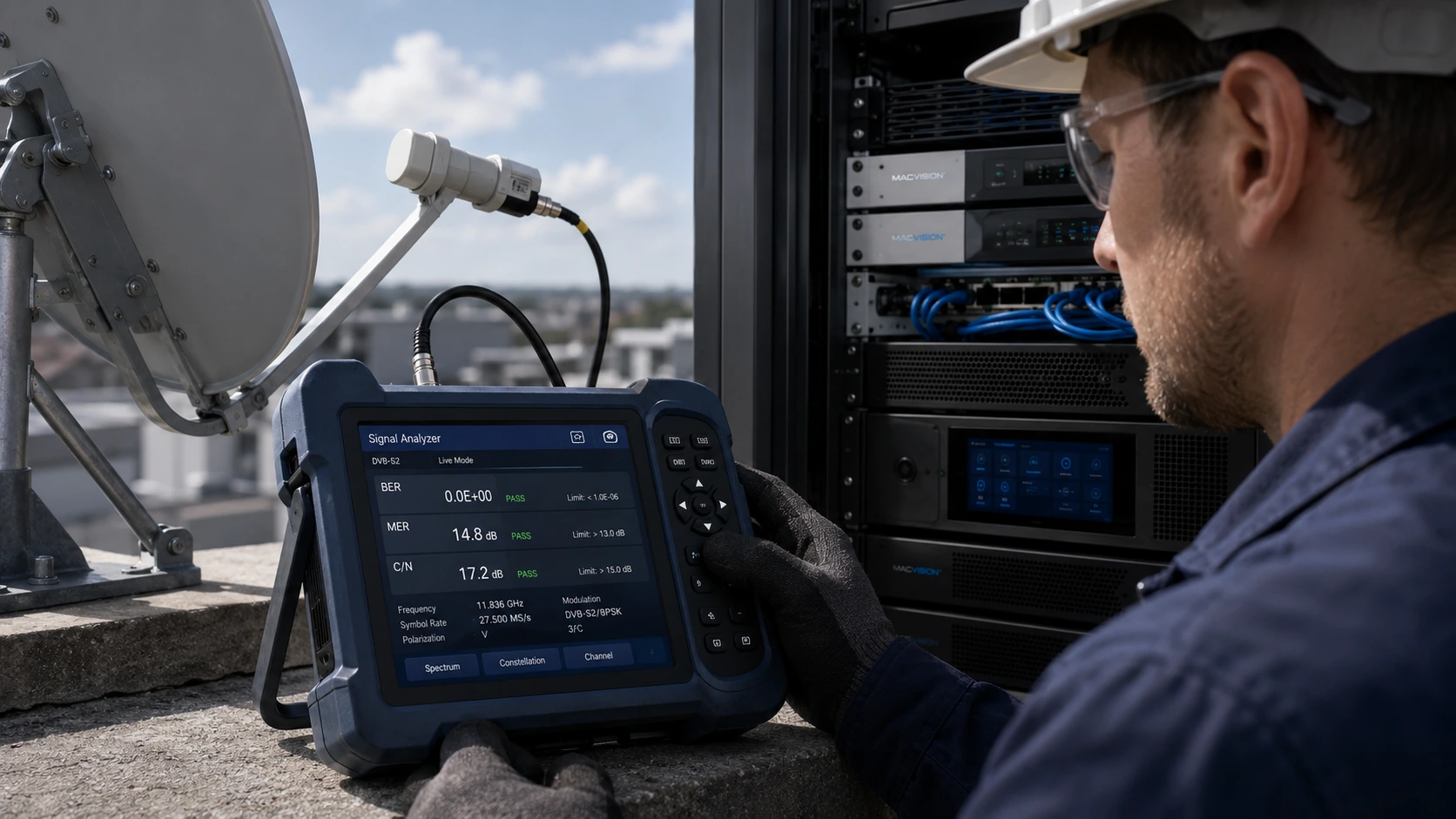
Professional satellite acceptance requires quality metrics that reveal how close a signal is to failure. C/N compares the carrier with noise, MER evaluates modulation accuracy and BER measures erroneous bits before and after error correction. These values are related but not interchangeable. A tuner may remain locked while pre-correction BER is rising, leaving little weather margin. Measuring at the dish, after RF distribution and at the headend input establishes whether degradation is caused by reception or by the internal network.
Which is more important for IPTV reception: signal level, MER or BER?
Answer: All are needed, but they answer different questions. Signal level confirms that the tuner input is within its operating range. MER indicates the quality of the modulation and is a strong indicator of margin. BER shows how many bit errors occur and whether forward-error correction can repair them. A high level with poor MER is not acceptable, and a low post-correction BER can hide a deteriorating pre-correction condition. Acceptance should therefore use the receiver manufacturer's thresholds plus a design margin for local weather and distribution loss.
Where should satellite quality measurements be taken in a headend system?
Answer: Measure directly at the LNB or dish test point, at the multiswitch input, at representative multiswitch outputs and at each critical headend tuner. This sequence reveals whether quality loss begins outdoors, across the cable, inside the switch or at a specific tuner. Use the same reference transponders and record level, MER or C/N and BER at every point. For large systems, include the longest cable path and any amplified branch. Historical records make gradual deterioration visible before guest complaints begin.
How can BER and MER readings be used to prevent IPTV channel outages?
Answer: Set warning thresholds above the tuner failure point and monitor trends rather than waiting for loss of lock. A gradual MER decline can indicate dish movement, corrosion, water ingress or LNB aging. Rising pre-correction BER on one quadrant can reveal a developing switch or cable fault. Combine RF alarms with transport-stream continuity monitoring so the operations team can distinguish reception errors from IP packet loss. Preventive action is justified when quality margin decreases consistently, even if viewers have not yet reported visible defects.